Have you ever worked on a laptop while watching TV? Maybe you’re answering emails while watching a TV show or movie. Chances are, you’ll notice one of two things happening. You get to the end of a sentence and realize that you have no idea what the characters just said. Or if you followed the show, you look back at your email and realize you’ve been staring at the same unfinished sentence for five minutes.
Yes, technically both things were happening at the same time, but you weren’t giving both your full attention. As a result, neither thing was done effectively. That’s the problem with what we often call multitasking. We assume that because we’re doing two things at once, we’re being more productive. But if we miss half the show and take twice as long to write the email, what did we actually acomplish?
Of course, not everything we do needs our full attention. Oftentimes I’ll work in the shop with a bike race or YouTube video on the shop TV. I’m under no illusions about the fact that I’m missing most of what’s happening on the TV because my primary focus is on the shop activity. Yet the TV stays on because I enjoy it. But when we’re talking about two tasks that actually require my full attention, something has to give. I just can’t give each one the attention it deserves and the quality of the results will suffer. This is the version of multitasking that I believe is a myth.
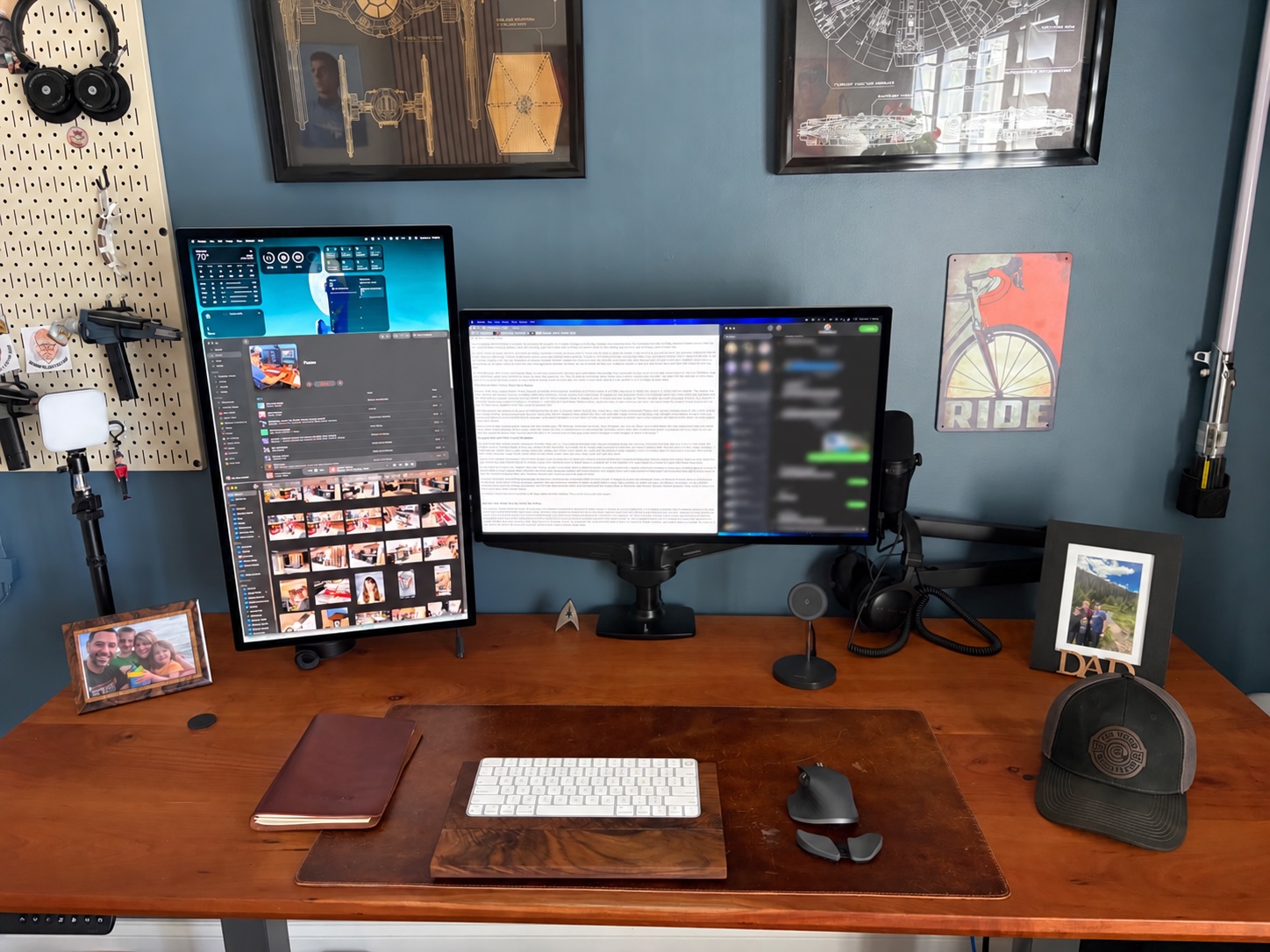
Task-Switching Has a Cost
The other version of multitasking is probably the one most of us actually try to employ: working on one thing, stopping to do something else, then coming back to the first thing. Instead of trying to do two things at once, you’re actually doing something called task-switching. And while I think task-switching is far better than true multi-tasking, the process of task-switching itself still takes time.
Example. You’re laying out a mortise and tenon joint when a notification comes in on your phone. You put down the pencil, pick up the phone, see that your wife wants you to pick up a rotisserie chicken on the way home, and send a quick reply. When you return to the bench, you have to quickly figure out where you left off. Which face was the reference face? Which end of the double square is the one with your setting? Where did the &%@(! pencil go?! The reply might have taken thirty seconds. Setting a reminder for when you leave the shop took 10 seconds. And that 40 seconds could come at the expense of spending even more time trying to get your head back into the layout task you were engaged in previously. Of course, this all increases the chances of making a mistake too, which will add even more time later on when you have to fix the error.
So check this out. A 2001 study by Rubinstein, Meyer, and Evans tested people repeating tasks and switching between them. You can read the full study here if you’re really bored, but let me sum up. Switching tasks added time, and the more complex the rules for that task, the greater the cost. They did find that certain cues about which task to perform helped reduce the delay. The study isn’t the end-all be-all on this topic, but it gives us a good reason to question whether all that bouncing around between tasks ever really saves us time. Being busy isn’t proof that you’re working more efficiently.
More Projects Don’t Always Mean More Progress
Recently, I had three projects underway at the same time: a laundry room makeover, rehabbing my old flaming table saw, and giving our Maker Bay a glow up. I didn’t do this on purpose. The laundry room project stalled when we had to wait for a plumber who ended up ghosting us. But now I have a YouTube degree in plumbing so it all worked out. While I was learning about PEX, I started rehabbing the flaming table saw. And when that project stalled because I was waiting for parts to ship, I began working on the Maker space. This process went on for several weeks a I bounced back and forth between projects. It took quite the toll on my mental state because I’m usually a “one project in – one project out” kind of guy. But every time I changed projects, I had to get back up to speed. Where did I stop? What’s next? Where did I put the stud finder? This is not my beautiful house! This is not my beautiful wife!

An additional layer of complexity that really only impacts weirdos like me, is remembering where I left off in the video. Every video I make is essentially telling a story. And the technical aspects of that include making sure I explain the things that need explaining and I get all the shots I need to supplement that explanation. Every video also tends to have a mood and energy level that should stay consistent through the production. Those things can easily be lost when that story is plagued with constant interruptions. Not only that, it’s all too easy to get confused as to which clips are on the memory card when it comes time to offload the footage. Ask me how I know.
You don’t need three concurrent major projects to run into similar issues. Even bouncing between two projects can be problematic and can slow down your overall progress. Of course that doesn’t mean you need to watch finish dry before starting something else. In fact, I use finish dry time as an opportunity to start planning the next project. I also use that time to catch up on things I’ve neglected while I was head down in the project. But what I don’t do is start another project in earnest. A new project doesn’t fully begin until the previous project is 100% complete, at least if I can help it.
Stopping Points and Other Coping Mechanisms
As someone that can’t stand having my attention divided too many ways, I’ve had to find techniques to cope when circumstances dictate task-switching. Something that really helps me is trying to find what I call “chapter breaks.” I didn’t need to finish the entire Maker Bay before working on something else. But finishing the electrical work gave me a clear natural stopping point. The electrical work was a single chapter in a greater story. And once that was done, I had an easier time walking away to work on something else. Sure, the overall project is still incomplete, but at least a major segment of the project is finished. That means it doesn’t have to occupy as much space in my brain and I can return to the project in the future with a fresh start on the next chapter.
I also try to limit outside distractions. In fact, when it’s time to focus, I like to put my phone out of reach and silence notifications. I’m also experimenting with focus modes on my devices. These will allow me to have unique layouts and notification settings for work time, home time, and exercise time. I haven’t gotten it all figured out yet but it promises to be super helpful for keeping me on task and limiting distractions.
Another thing I’ve started to do, especially when I’m forced to break away from a project at an inopportune time, is making written notes. I almost always shave a notepad on the bench and it only takes a few seconds to write down two very important things: what I just did and what I was going to do next. You’d be surprised at how effective that can be when you need to change gears and you might not get back to that project for a few days. In the past I used to think “oh I’ll remember where I was” only to be proven wrong a week later.
Honestly, it think all of us could benefit from taking some time to evaluate how we multi-task and task-switch. Is it truly working for us or are we just operating under an illusion of efficiency? Maybe even try some experiments. Compare doing focused purposeful single tasks and taking them to completion before moving onto the next thing. Time yourself. See if there’s any logic to what I’m proposing here. And if you’re anything like me, a slightly neurotic over-thinker, you just might find additional peace of mind and satisfaction by eliminating the noise and giving each task the proper amount of attention. I truly think your work will benefit from it and you’ll get done sooner.
I’m curious to hear about your experiences with muti-tasking and task-switching. What works for you and what doesn’t?
An Ironic Note About How This Article Was Written
The original idea for this article came from a stream of consciousness I recorded by dictation on my phone sitting in my truck in a Lowe’s parking lot. I was making yet another trip for something related to the Maker space and I had all these thoughts swimming through my head. The original article turned out to be an incredibly disjointed 3050 word essay that was as meandering as my dog Abby when we’re walking through the park. I had so much on my mind at the time, that a budding idea for an article was a welcome distraction so I put words to my thoughts. The reality was, they just weren’t all good words. And I kept losing the plot with analogies about computer monitor setups, my wife’s doom piles throughout our house, and many disjointed paragraphs that read more like complaints than advice. So I decided to save you from that torture and instead distill the whole thing down to some simple points I was hoping to convey. But just know the irony behind this article is that it all started by trying to multitask, and it kind of sucked as a result. The final article only came about when I sat down at the computer, distraction-free, and rewrote the whole thing.
