
I had to do something recently that I haven’t done in a long time: I had to match an old finish. I was in the middle of repairing an old bookcase I made for my mother-in-law about 22 years ago (I believe it was my third real project), and one of the repairs involved reinstalling the shiplap back. Apparently, attaching pine tongue-and-groove boards by brad nailing into the end grain isn’t a great idea. Who knew?!
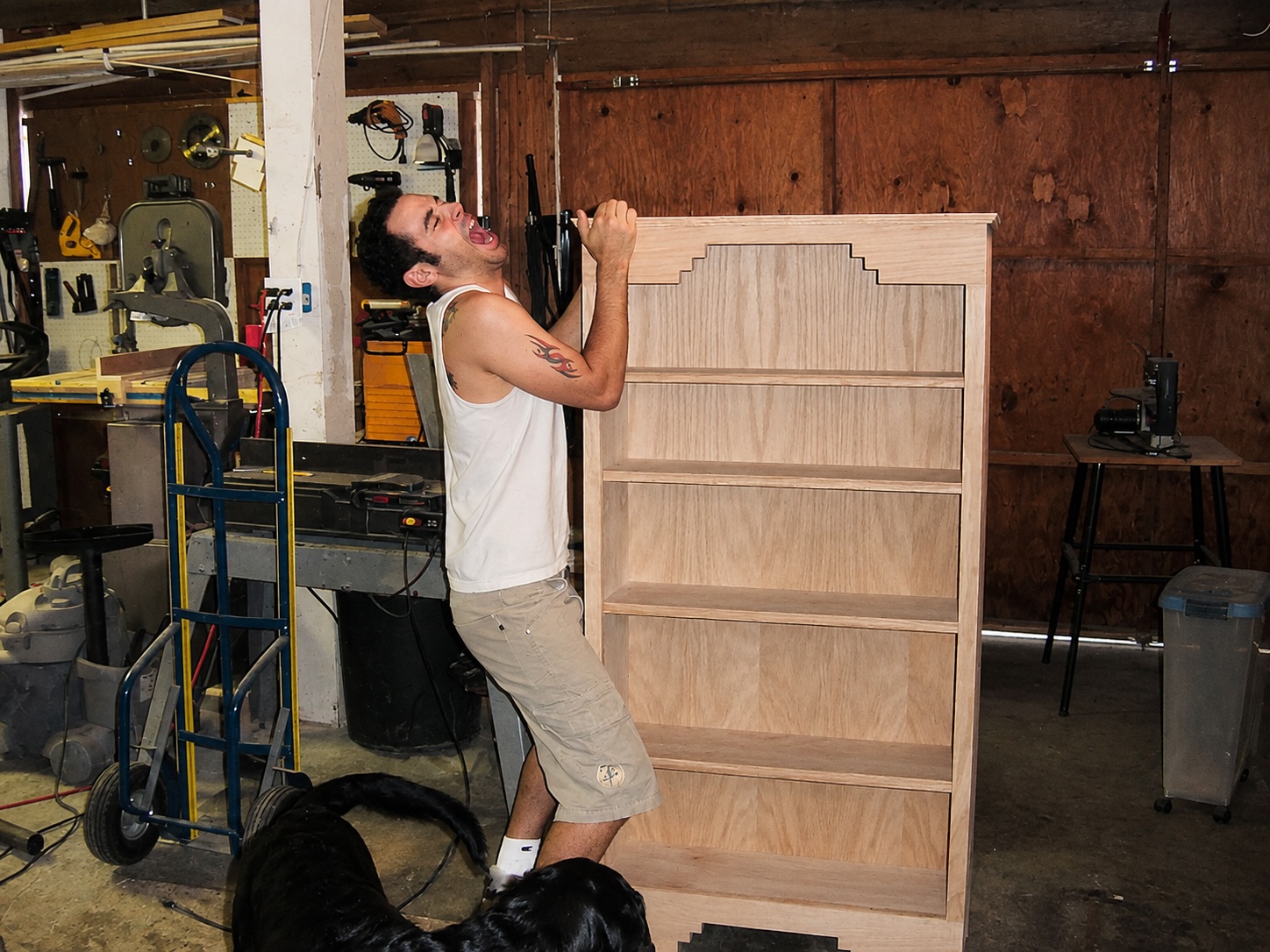
When I went to reattach the boards, I realized that a few were missing. Finding replacement boards wasn’t a problem but matching the finish was. Apparently 2004 Marc wasn’t thinking ahead and documenting his finishing recipes for future Marc. 2004 Marc did lots of questionable things as you can see below.
So I had think back to that time in my woodworking journey to see if I could remember what kind of finish and stain I may have used. I know for sure I was watching a lot of Woodworks and The New Yankee Workshop. David Marks used a lot of Arm-R-Seal, basically a wiping varnish, while Norm often used shellac and polyurethane. So there’s a good chance I used shellac as a base coat followed by wiping poly for more protection, but the bigger question was the color. The bookcase has that orange/amber tone pine can develop with age but the color is way too intense to be natural. And when I look at the back boards I can see colored drips, indicating a staining product of some kind was used. I know I wasn’t really into oil-based stains at the time and I do recall having a pretty spiffy collection of dyes at my disposal. So my best educated guess was that I used dye in shellac as a stain coat, followed by a wiping varnish topcoat.
Free from Marc
Marc’s Finishing Quick Guide
The finishing mistakes Marc sees most, in one printable guide. Big, easy to read type, made to tape to the shop wall.
- Picking the right finish for the job
- Scratches that show up after the finish goes on
- Blotch control
- Real dry, recoat and cure times
- Rough final coats
- Why switching products usually isn’t the fix
Thanks! Check your inbox, the guide is on its way.
Something went wrong. Please try again.
We will email you the guide. Unsubscribe any time.
Want to watch it done? Wood Finishing in Practice
11 Guild lessons, over 7 hours: oils, hardwax oils, wiping varnish, water-based, lacquer, spraying, outdoor and workbench finishes, all on real furniture. $49.
Prefer to read? Marc’s finishing book, $10
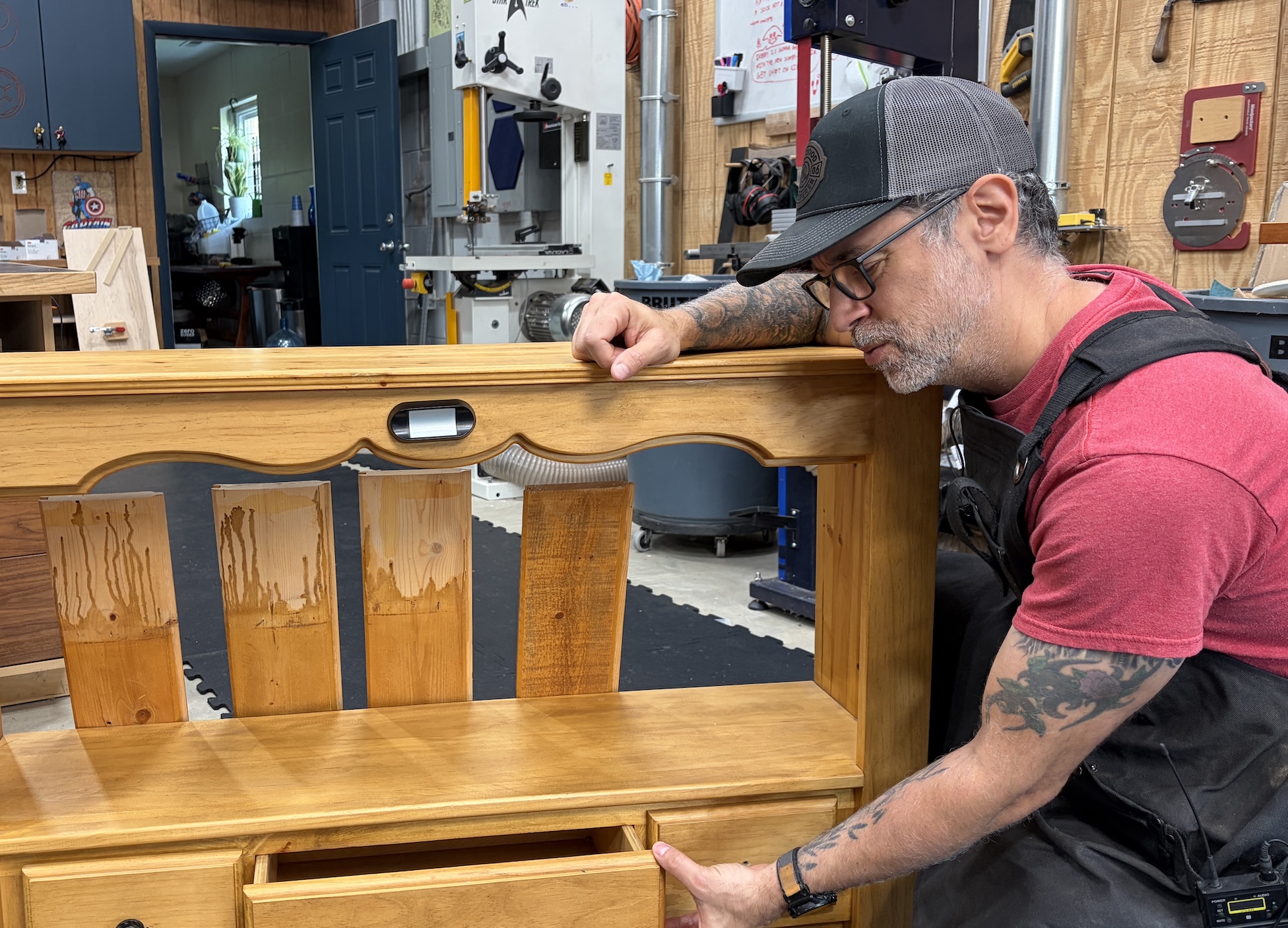
It’s important to consider that time also complicates color matching. This finish is more than 20 years old and even if I had the exact recipe, there’s no guarantee that it would match the current appearance of the finish. Thankfully, my mother-in-law isn’t all that picky. As long as I get close enough, it’ll be good enough. So I grabbed some scrap, a can of Zinsser shellac, and a few TransTint dyes. Shellac alone was clearly too blonde. So I put in a few drops of Vintage Maple dye. That warmed things up but the color still lacked the brown punch of the original so I added some brown. It took about four rounds dropping and testing but the final result looks close enough. As my stepdad used to say, “You’ll never notice it riding a horse at 50 mph down Broad Street” I still don’t know what he meant but it somehow seems to apply here.
During this color creation exercise, I realized something: I’m rusty! I haven’t done color matching in ages, and I probably haven’t used shellac in more than ten years. That brought to mind a very scary question: do woodworkers need traditional finishing skills anymore?

I Used to Do This Stuff All The Time
Before The Wood Whisperer became my regular gig, I got a job working part-time at a small refinishing shop in Phoenix. While I certainly had a good deal of woodworking skills at the time, my finishing experience fell short. At that point in my career, I had yet to touch a spray gun, lacquer terrified me, and I knew more about food dye than wood dye. The owner, Cody, taught me about topcoats, HVLP, repairs, color matching, toners, and all the small details required to make old work look new and new work match old work.
This was all super interesting, but the thing that really tickled my cheese was the chemistry. My degree is in biology and I have a minor in chemistry, so I naturally wanted to know why finishes worked the way they did, not just how to apply them. Understanding things like cross-linking, oxidation, and solvent evaporation helped explain differences in curing, hardness, durability, and repairability. But chemistry only gets you so far. Finishing also requires judgment. It truly is an intersection of chemistry, art, and patience.
After about a year, things really started to pick up on The Wood Whisperer side of things so I had to move on. But I’ll always be thankful to Cody for teaching me and inspiring me to take finishing a lot more seriously. I eventually went on to share much of what I had learned through my videos and my book, Finishing: It Ain’t Over Till It’s Over.
Back then, I used those skills regularly. Today? Not so much. And I don’t think I’m alone.
Finishing Used to Be a Craft Within the Craft
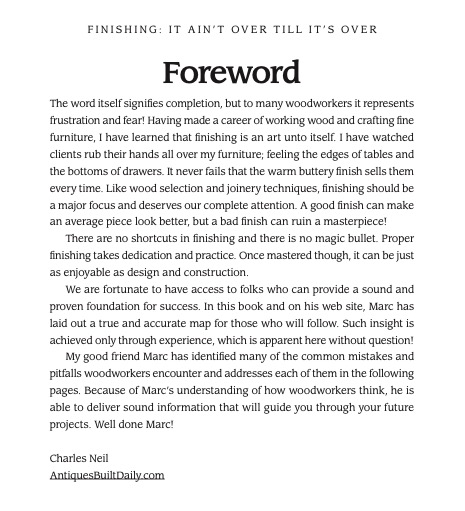
When my finishing book came out in 2011, I asked the late Charles Neil to write the forward. He called finishing “an art unto itself” and he argued that it deserved the same attention we give wood selection and joinery. Like any other part of woodworking, getting good at finishing takes practice. A skilled finisher knows how to prep a surface, how different species of wood respond to color, the difference between dyes and pigments, how to control blotching, how to build color with toners, how to rub out a finish to a desired sheen, and perhaps most importantly, they know how to fix the situation when everything goes sideways.
So here I was, in my shop with a 22 year old finish as a visual reference and nothing but my memory to go on. But I had some scrap wood and a cabinet full of finishing products. Solving this problem was well within my wheelhouse. Granted, this is a tame example and not an extremely challenging situation, but problems like these are why finishing has long been a specialty of its own. In fact, some woodworkers don’t actually finish their own projects. Fine Woodworking has an article about when it makes sense to outsource finishing, especially when a job calls for difficult color work or experience the builder doesn’t have. Well-respected woodworkers I know personally, including Tommy Mac and Darrell Peart, have outsourced finishing for much of their careers.
We don’t assume a great furniture maker will also be a great upholsterer, metalworker, or glassmaker. Why should finishing be different? And while you don’t need to be an absolute expert to finish your own work, it still takes knowledge, judgment, and practice. At least it used to.
Then Finishing Got Easier
Sometime within the last 10 years, hardwax oils became a major part of the online woodworking world. They had been around for years, especially in Europe, but suddenly Rubio Monocoat was showing up everywhere in videos…usually about slab tables. That’s actually what prompted me to make a video about applying Rubio on smaller furniture projects. And soon there were new brands popping up left and right. Recently, even companies that were already well established with woodworkers, such as General Finishes, have entered the category with their own hardwax oil. Eventually there were enough brand options that I felt compelled to make a hardwax-oil comparison video in hopes of making sense of it all. Whatever else you think about them, hardwax oils are now firmly mainstream.
I have to laugh because I initially dismissed them. I recall Rubio sending me a sample ages ago and I didn’t think much of it. It just seemed like an expensive version of something we could make ourselves by mixing classic oil and wax. But that was a big misunderstanding on my part and totally undersells what these finishes do and how they work. The chemistry varies by product but Rubio says Oil Plus 2C bonds at the molecular level with the uppermost wood fibers, eliminating the need for multiple coats. Osmo takes a different approach, combining penetrating oils and waxes to create a thin protective layer.
While this was all very interesting technology, it was the practical results that made me a convert. These products use very little material. They don’t require building a substantial film. They dry quickly and cure within about a week. And the application process couldn’t be simpler. Spread it thin, buff it in, let it soak, wipe it off, then buff dry. No four to five coat week-long process. No sanding between coats. No fighting dust nibs and streaks. No overspray. And in most cases, nothing stinking up the shop.
Hardwax oils also arrived at the right time with regard to trends. For quite a while now, people have been leaning toward wood that looks and feels like real wood. Gone are the days of heavy build finishes that look like plastic or glass. Satin and matte are the sheens du jour and people just can’t get enough of that natural wood texture. However, if everyone suddenly decides piano-gloss finishes are back in style, hardwax oils are pretty much screwed. But for now, low luster is where it’s at so the limited sheen range isn’t much of a concern.

Hardwax oils are also easy to repair. You can often sand the affected area, apply more finish, buff it off, and no one will be the wiser. Easy peasy. You can’t do that with most traditional film finishes.
Most importantly, hardwax oils have lowered the skill required to get good results. In the past, you could often spot an inexperienced woodworker by their finish. Brush marks, drips, blotchy stain, and enough polyurethane to make the table look like it had been dipped in plastic. I’ve judged competitions where a project looked great from a few feet away but felt like 80-grit sandpaper when you touched it. No bueno! Today, someone can be on their first furniture project, wipe on some hardwax oil, and get a clean natural-looking finish. That’s a good thing! Hardwax oils have essentially democratized finishing.
Technique Focus vs Product Focus
Something else changed along the way. Just look at finishing discussions on YouTube, Instagram, or Reddit and many of the questions are purely focused on brands. “Should I use Rubio or Osmo?” “Is Natura any good?” “How do these compare Odies?” I get it. People like me are part of the reason these products are discussed so often. We use them, we test them, and we talk about them frequently. But it’s a bit troubling to me that the conversation has shifted so dramatically from techniques and various finishing systems towards individual products. Instead of asking, “What combination of color, protection, and sheen does this project need?” we often start with, “Which hardwax oil should I buy?” as if the type of finish itself is a forgone conclusion.
That’s really not a good thing. Hardwax oils generally don’t provide the same film build or abrasion protection as traditional film finishes, and most are firmly in the matte/satin range. When someone wants more protection or a different appearance, the go-to option today is to apply an additional (expensive) ceramic coating on top. Now there’s really nothing wrong with that. I have used these ceramic topcoats myself. But think about what has happened here. We’ve taken a finish, prized for its simplicity and ease of use, and started adding products to compensate for what it doesn’t do well. Meanwhile, older finishing systems may already provide the protection and sheen we want, often for much less money.
Traditional finishes also give you far more ways to solve specific problems. Need to shift color without obscuring the grain? Try dye stain. Need two boards to look more alike? Try toner, gel stain, or a homemade pigmented stain. Blotchy wood? Use Marc Juice. Want a specific sheen? Fill the pores, build a film, and rub it out. Simply put, traditional finishes give you infinite options. Hardwax oils are a little more “you can have any flavor you want, as long as it’s vanilla.” Granted, vanilla is pretty damn popular right now and happens to delicious. But you’re still working within a fairly narrow range of low-build, natural-looking, matte/satin finishes. If that’s the result you want, great. If not, you’ll need to either start adding other costly products to your collection or do a little research into the wonderful world of other finishing systems.
The Durability Question
One of the main hallmarks of hardwax oil is how easy it is to repair. But don’t confuse repairability with durability. A thin, close-to-the-wood finish is very different from a film designed to act as a protective layer on top of the wood. One of the things you’ll hear folks say about hardwax oils is “If they’re durable enough for floors, they’re durable enough for furniture!” Unfortunately, that’s a bit misleading. Yes, of course hardwax oils can be used on floors. In fact, I used Osmo on my own kitchen floor and I can speak first hand about the durability. But since most floors are made from incredibly hard woods like oak, maple, and hickory, the lion share of the durability comes from the wood itself. All the finish really needs to do is prevent liquid penetration and staining. Hardwax oils can do at least that much and the wood fibers do the rest. I have two kids and two dogs, and my hardwax oil floor still looks pretty good after a year with zero maintenance. It has a lot more scuffs and scratches than a film finish would, but the matte appearance helps hide those blemishes and when I’m ready to do a refresh, the floor will once again look new.
And that’s really where the tradeoff is: maintenance. A film finish may resist wear longer but hardwax oil is easier to deal with when wear eventually occurs. A homeowner can easily DIY a repair on a floor finished with hardwax oil, not so much with a traditional finish. The same concept applies to furniture.
There’s another advantage for hardwax oils: many contain little or no VOCs. Natura Onecoat is sold as VOC and solvent-free. That makes it far more pleasant to use and it won’t off-gas noxious odors once inside your home. Compare that to most solvent or oil based finishes where the fumes will knock you on your butt if you’re not careful, and they often emit odors for weeks or months.
Finish Follows Function
I have an entire chapter in my book called “Finish Follows Function,” and I still think that’s the best way to approach finishing. A kitchen table will see daily abuse from kids, keys, dishes, moisture, heat, cleaning reagents, etc. These are all things a classic film finish will handle fairly well, protecting the wood that lives beneath it. Something like a cutting board has very different needs. We’re not looking for maximum build or scratch resistance because we’re literally going to attack it with a knife. Food-grade mineral oil, pure tung oil, or an oil/wax blend makes more sense because slows down absorption of liquids, won’t flake off, and is easy to renew.
Before choosing a finish, try to identify what the piece actually requires. How will it be used? Where will it be stored? How much abuse will it likely receive? Does the finish need to be repairable? Also think about stuff like VOCs, food contact, color, and sheen. These questions will lead you to a specific finish. If you start your inquiry with the question “Which hardwax oil should I buy?” you’ll potentially deny yourself a chance to discover a more appropriate/superior finish option.
What Happened to Finishing Books?
Writing this article reminded me of two books many of us once considered required reading: Bob Flexner’s Understanding Wood Finishing and Jeff Jewitt’s Taunton’s Complete Guide to Finishing. I can’t help but ask the question: are they still useful to someone who started woodworking in the age of hardwax oils? Man, I sure hope so!
Both books cover topics like surface prep, staining, pore filling, spraying, and reviews of various finish types. They also cover just about every finishing technique under the sun. Those techniques didn’t suddenly stop working just because easier products hit the market. These books teach something a product application tutorial usually doesn’t: how and why finishing works. Once you understand things like how shellac is made, why a film offers more protection than an oil, how dyes and pigments differ, and how oil finishes cure, you’re no longer limited to somebody else’s recipe or the instructions on the back of a can. Both of these books were pivotal in my own finishing education as they went beyond the “what” and fully explained the “how” and “why”.
If there’s a downside to these books, it’s that so much information can be overwhelming. And the option to choose any finish out there can often lead to decisions paralysis. My advice has always been to pick one finishing system and use it repeatedly for a while. After all, it’s better to be good at one finish than mediocre at 20. Now that I think about it, it’s that line of thinking that landed us in this situation in the first place. If someone is getting good results with hardwax oil, why should they bother exploring more complicated options? As you can see, I’m a little conflicted.
But I honestly believe that mastering one finish should only be the start of the journey, not the end. You don’t need to know everything and you should at least know what else is possible in the world of finishing so when a project calls for something different, you know where to look and you know what to do. Flexner and Jewitt are still great places to start.
Maybe My Perspective Is Skewed
When I was learning woodworking, I tried to emulate professional woodworkers and finishers. I read their books, spent time in professional shops, then went home and practiced what I learned. Today, many newer woodworkers are learning online. Their teachers are the people they watch on YouTube, Instagram, and TikTok. People whose jobs include making content, getting views, and promoting products. People like me. Although it’s been a while since I’ve visited a production shop, I suspect traditional, more durable finishes are still being used widely. So why are they becoming less common among hobbyists and small shops? Is it because people stopped emulating the pros, or just that we’ve changed who the “pros” are? I suspect the latter.
I guess I’m hoping that my closeness to the online woodworking community gives me a limited and skewed perspective on what’s actually happening greater woodworking world. Perhaps more folks are using traditional finishes than I realize and maybe this article is blowing this whole thing out of proportion. I would love to be wrong about this. If you have a different perspective, please let me know in the comments.
This is probably a good time to mention that I currently have a working relationship with Natura Onecoat, a hardwax oil I genuinely like and use. So yes, I’m part of the “problem.” But liking Natura doesn’t change the point of this article. It’s an excellent option when its strengths line up with what the project needs. It just isn’t the answer to every finishing problem, and neither is any other finish.
The Skill I Almost Forgot I Had
That bookcase reminded me of something. I had no idea how I finished it 22 years ago. I didn’t know the color or have a recipe to follow. But I had the tools and knowledge to figure it out. That knowledge came from years of screwing things up, doing research, reading books, experimenting in my own shop, and working alongside people who knew far more about finishing than I did.
I don’t need those skills as often anymore, and I’m not giving up hardwax oils. But convenience shouldn’t become the limiter for what we know how to do. Sometimes a project needs shellac. Sometimes lacquer. Sometimes dye, toner, varnish, or something else entirely. And if you’re building for someone else, their needs may lead you somewhere different than your own habits or preferences would.
So don’t hesitate to use hardwax oils when they make sense. Just don’t forget that there are other excellent options out there. And make sure you learn enough about those other options so you’re ready for that inevitable day when your ‘go-to’ finish fails you. That’s when all of this additional finishing knowledge really pays off. It feels good knowing you can troubleshoot just about any finishing challenge that comes your way. When your friends ask you to put a high gloss finish on their dining table, you can confidently say “I can do that!” When your wife says she isn’t happy with the finish on that cutting board you made her, you can offer her some alternatives. And when your neighbor asks if you can help refinish their front door, you can wisely turn down the job but make some solid recommendations on what they should try and who else they should contact to do the work. I might be project here.
But in the end, the goal is to be best looking, most talented finishing hero in your one-person shop. I know I am!
Free from Marc
Marc’s Finishing Quick Guide
The finishing mistakes Marc sees most, in one printable guide. Big, easy to read type, made to tape to the shop wall.
- Picking the right finish for the job
- Scratches that show up after the finish goes on
- Blotch control
- Real dry, recoat and cure times
- Rough final coats
- Why switching products usually isn’t the fix
Thanks! Check your inbox, the guide is on its way.
Something went wrong. Please try again.
We will email you the guide. Unsubscribe any time.
Want to watch it done? Wood Finishing in Practice
11 Guild lessons, over 7 hours: oils, hardwax oils, wiping varnish, water-based, lacquer, spraying, outdoor and workbench finishes, all on real furniture. $49.
Prefer to read? Marc’s finishing book, $10